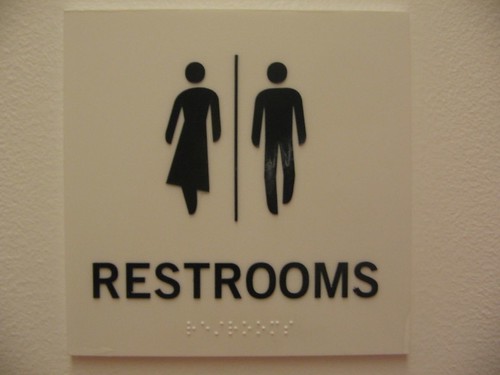
Relieving yourself outside the comfort of your own bathroom can give even the overly confident some understandable anxiety, sometimes. But for transgender people, it can be more than just nerve-racking, it can dangerous.
A recent survey, published in the Journal of Public Management and Social Policy, found that 70 percent of responders have been denied entrance, were harassed or assaulted when attempting to use a public restroom of their identifying gender.
And it’s no surprise that these traumatic experiences affect the daily life of transgender people, the survey points out. More than half of respondents reported having physical problems, including dehydration or kidney infections, because they “held it” to avoid using public bathrooms.
More than half also said they have skipped leaving the house because they didn’t feel safe in public, the study says.
In addition, Discrimination at the workplace has influenced more than 25 percent of respondents, who say that they experience problems using bathrooms at work, which, in some cases, was the reason they left or changed jobs. About 10 percent of respondents who attend school reported having excessive absence rates or dropped out.
Although the survey focuses on the Washington D.C. population, researchers say the problems could be more widespread as transgender people become more visible.
The Transgender Law Center found similar results in San Francisco, when it completed another survey in 2002. Herman said she is not sure how much has changed in the City, however, this problems seem to occurring nationwide.
“Just because it took place in D.C. doesn’t mean they aren’t having those problems elsewhere,” she said.
The survey concluded that cities should adopt laws that explicitly give transgender people legal protection in bathrooms. Additionally, it recommends creating unisex bathrooms to avoid the problem altogether.
Laws and policies regarding gender changes have traditionally posed difficult hurdles for transgender people. Many such policies were written decades ago, when the predominant understanding of gender reassignment was that every transgender person underwent a single “sex change operation”–genital surgery–and no transition could be complete without it. But this (mis)understanding has changed over the past 20 years as medical knowledge has advanced and as transgender people have become outspoken advocates for themselves.
Transgender health experts now recognize that gender transition is an individualized process that can involve a variety of steps–sometimes involving surgery, but often not. In short, gender transition is anything but cookie-cutter. That updated understanding of gender transition is beginning to inform policy makers’ decisions and what impact of LGBT supportive policies have in the workplace.
That’s why, in 2009, the New Jersey Motor Vehicle Commission revised its policy for changing the sex designation on a driver’s license. The new policy simply requires a statement from a health care provider that the license holder’s gender identity is male or female “and can reasonably be expected to continue as such for the foreseeable future.”
After the new policy took effect, Mark was able to change the sex designation on his driver’s license to “M” and is no longer worried about showing his license, if he gets pulled over.
At this time, it is still typical in most of the country for administrative agencies and other entities to require a transgender person to have surgery before the new gender is recognized. But changes in policies, such as the one New Jersey adopted (itself coming on the heels of a similar move by the Massachusetts Registry of Motor Vehicles), are more common than they used to be. This shift is consistent with a broader trend toward respecting transgender people’s identity. Increasingly, anatomy is not the final word.
Evidence of this shift can be found in a variety of contexts. For example, in June 2009 the National Prison Rape Elimination Commission (NPREC) released standards for combating prison sexual violence. The standards recognize that transgender prisoners are particularly vulnerable to abuse.
Currently, most prisons house transgender inmates according to their genitals–in other words, transgender women with male genitals are housed with male inmates, regardless of their identity, transition status, and other risk factors.
The NPREC’s standards deem this approach unworkable and urge agencies “to give careful thought and consideration to the placement of each transgender inmate and not to automatically place transgender individuals in male or female housing based on their birth gender or current genital status” (for more, see www.nprec.us).
Evolving understanding of transgender lives and identities is playing out in the employment law context as well. Since 2001, 12 states and dozens of cities and counties have enacted laws banning employment discrimination on the basis of gender identity. In 2009 a federal employment non-discrimination act that would prohibit gender identity and sexual orientation discrimination in the workplace was introduced in both houses of Congress. Even in the absence of explicit gender identity provisions, a number of courts have held that federal and state sex discrimination laws that prohibit sex stereotyping also protect transgender workers.
But workplaces are not always gender neutral. For example, courts permit employers to establish different dress and grooming codes for men and women provided that the code doesn’t impose an unequal burden on one sex or the other. In other words, a policy that requires women to wear miniskirts, halter tops, and high heels but permits men to wear slacks of their choice would not pass muster.
But where do transgender employees fit? In 2009 an Indiana federal court held that a convenience store had the right to fire Amber Creed, a transgender woman, because her hair was slightly longer than the length permitted by the dress code for male employees ( Creed v. Family Express, 2009 WL 35237 (N.D. Ind. 2009)). That decision is unlikely to be the last word on how dress codes apply to transgender employees.
Like dress codes, restrooms also segregate by sex. People opposed to gender identity protections in the workplace and beyond have raised questions about restroom access. If transgender people are permitted to use the restroom consistent with their identity, they ask, how will we stop the male predator who falsely claims to be a woman in order to enter the women’s restroom?
Of course, signs on restroom doors are not talismans that deter criminals who are bent on causing harm–that’s what our criminal laws are for. And in the 100-plus jurisdictions that have enacted gender identity protections, there has been no outbreak of restroom violence committed by faux transgender people. But these arguments about restroom access highlight a fundamental cultural anxiety: If anatomy is not the factor that determines gender, how will we know who is truly a man or a woman? In short: How will we know who is “real”?
Concerns about “realness” have a palpable effect on legal approaches to transgender issues. In 2009 a transgender man in New York filed a name-change petition, seeking to change his first name from Leah to Olin. Although Olin complied with all legal requirements and swore that he did not seek the name change for fraudulent purposes, Judge Manuel Mendez ordered him to bring in a letter from a doctor or psychologist confirming the need for the name change. Olin later learned that Judge Mendez routinely required transgender name change petitioners–and only transgender name change petitioners–to supply medical evidence. In May 2009 Olin appealed Judge Mendez’s denial, arguing that the additional evidentiary burden was unauthorized by statute and raised constitutional concerns. In October 2009 the Appellate Term of the New York Supreme Court ruled in Olin’s favor, holding that “[t]here is no sound basis in law or policy to engraft upon the statutory provisions an additional requirement that a transgender petitioner present medical substantiation for the desired name change.” Judge Mendez has been reassigned.
Lawyers sometimes use fears about transgender people’s “realness” and authenticity in strategic ways. In 2002 Gwen Araujo, a 17-year-old transgender woman, was beaten and killed in Newark, California. Her killers asserted a “trans panic” defense at trial–in other words, they claimed that they were so perturbed to learn that Gwen was “really a man” that their criminal culpability for her death was lessened. In 2005 the jury rejected the “trans panic” defense and convicted two of the defendants of second-degree murder.
Although cultural anxieties about ascertaining gender persist, legal principles of dignity and respect for the expression of identity increasingly overshadow them.
Challenges persist, but there is a clear movement toward the recognition, in law and policy, that gender identity is a fundamental personal characteristic that must be recognized and respected. Social media has lead to social change, by helping to educate the public and personalize statistics. We’ve come a long way since courts only overturned anti-cross-dressing laws because of their effect on non-transgender people. Transgender lives are no longer just a footnote in the law books, their identities no longer uniformly bound to surgical requirements. As principles of dignity and equality move into the forefront of legal thinking, transgender people are not an afterthought anymore.
Devon Grey publishes articles at QueerWorld which is a LGBT business-networking environment providing a venue to develop and expand your trusted network of business professionals. By supporting the LGBT community we support you! United, we make positive local and global changes.
Restroom Related Items For Sale
[phpbay]transgender bath, 2, “”, “”[/phpbay] [phpbay]restroom, 12, “”, “”[/phpbay]
Oregon high school creates unisex bathrooms for transgender students
Northeast Portland’s Grant High School, addressing an issue schools increasingly face across the nation, has created six unisex bathrooms in response to…
Read more …
Restroom Transgender

